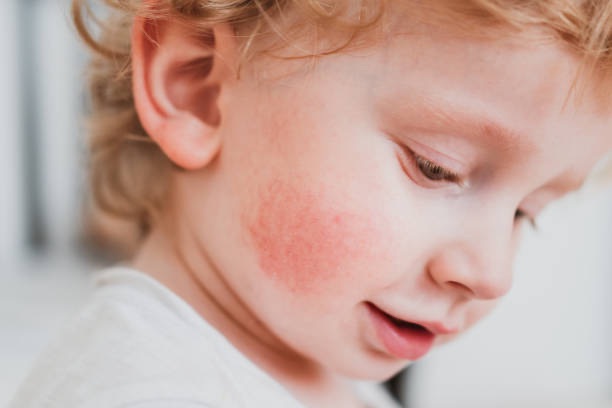
My daughter had perfect skin.
The only rash she had ever experienced was a mild heat rash from baby wearing in the summer.
Then I took Bactrim (an antibiotic) while breastfeeding — and within weeks, everything changed.
If you are here because:
- You’re dealing with eczema
- Your toddler suddenly developed a rash around their mouth
- A steroid helped… then made it worse
- You suspect something deeper like gut imbalance
I see you.
This is our story.
What Happened After Antibiotics While Breastfeeding
My husband and I contracted parasites in Mexico. I became severely dehydrated and was prescribed Bactrim for 10 days.
Before taking it, I specifically asked:
“Is this safe while breastfeeding?”
I was told absolutely yes.
So I continued nursing my 10-month-old.
Within two weeks, I noticed something new:
- Undigested food in her stool (carrots, blueberries — foods she had previously tolerated)
- An inflamed rash on her eyelid that looked like a stye
The timing felt connected.
Antibiotics are known to alter the gut microbiome. Emerging research on the gut-skin axis suggests that microbial imbalance can influence immune responses — especially in infants.
But no one asked about her gut.
From Eyelid Eczema to Steroid-Induced Perioral Dermatitis
Her pediatrician diagnosed eczema and prescribed Desonide 0.05% cream.
Her eyelid improved.
Then she developed a spreading rash around her mouth.
This condition is known as perioral dermatitis, and topical steroids on the face are a documented trigger.
Desonide Side Effects Can Include:
- Skin thinning Burning or irritation
- Rebound flares after discontinuation
- Steroid acne
- Perioral dermatitis
When we stopped the steroid, the eyelid rash came back worse.
The rash around her mouth spread.
This is often referred to as a steroid rebound flare.
The Dermatology Appointment That Changed My Trust
We were referred to dermatology because we needed to stop the steroid.
I came prepared.
I wanted to explain:
- The antibiotic exposure through breastmilk
- The undigested food in her stool
- The exact timing of the rash
The dermatologist:
- Was late to our appointment
- Looked at my daughter’s skin for maybe 20 seconds
- Prescribed Pimecrolimus 1%
The appointment lasted maybe five minutes.
When I tried to bring up the gut connection, I was cut off mid-sentence.
The topic was changed.
It was dismissed.
And I left feeling like another “overthinking mom.”
If you’ve ever felt dismissed or gaslit in a medical setting, you know the feeling.
The Black Box Warning That Made Me Pause
At the pharmacy, I looked up pimecrolimus.
It carries an FDA black box warning.
What Is a Black Box Warning?
A black box warning is the strongest safety warning the FDA issues. It signals potential risk of serious or life-threatening adverse effects.
For pimecrolimus (and similar calcineurin inhibitors), the warning was issued due to:
- A theoretical risk of lymphoma
- Possible malignancy risk with long-term use
- Concerns about immune suppression
While dermatologists often state the risk is theoretical and rare, it is still the highest level warning the FDA gives a medication.
Additionally:
- It is generally used cautiously on the face.
- It can cause burning and irritation.
- It is not typically first-line for infants without careful consideration.
This was to be applied around her eyes and mouth.
I walked out of the pharmacy.
I didn’t even wait for it to be filled.
When I messaged the office, they insisted it was safe.
At that point, I was done hearing “this is safe.”
I Trusted My Gut (And Started Researching the Gut-Skin Axis)
I began researching the gut-skin axis.
The gut and skin are connected through:
- Immune signaling
- Inflammatory pathways
- Microbial balance
- Barrier integrity
Studies have shown gut dysbiosis is associated with eczema severity in children. Certain probiotic strains have demonstrated improvements in inflammatory markers and skin outcomes.
Instead of suppressing her skin, I wanted to heal her gut.
The Probiotic That Changed Everything
At 12 months old, I started her on a probiotic from Hiya (labeled 2+, but she was eating solids and I carefully reviewed strain safety).
Within 2 Weeks:
No more undigested food in her stool.
That was my first sign.
Within 1 Month:
Her skin began to calm.
We supported topically while her gut healed:
- Colloidal silver gel
- Boudreaux’s Butt Paste
Zinc oxide is helpful in perioral dermatitis because it:
- Dries excess moisture
- Protects against saliva irritation
- Supports barrier repair
It kept things controlled — but it didn’t fully clear her skin.
The probiotic did.
Six Weeks Later: Completely Clear
At about 1.5 months:
- No eyelid rash
- No perioral dermatitis
- No inflammation
We transitioned to rebuilding her skin microbiome and now simply use CeraVe Moisturizing Cream.
She is now 2 years old.
She has never had another flare.
She still takes probiotics daily.
What Parents Should Know About Toddler Eczema & Perioral Dermatitis
- Not every rash labeled “eczema” is simple eczema.
- Perioral dermatitis in toddlers can be triggered or worsened by topical steroids — especially on the face.
- Steroid rebound flares are common after discontinuing facial steroids.
- Antibiotics can influence the gut microbiome, and the gut plays a role in immune and skin health.
- Persistent rashes deserve curiosity, not dismissal.
- Parents are allowed to ask questions and seek root causes — not just symptom control.
Every child is different. But patterns matter. Timing matters. And parental intuition matters.
Shop My Routine: What We Actually Used to Heal Her Skin
(This is not medical advice — just what worked for our daughter.)
1. The Gut Support (The Game Changer)
Daily Probiotic:
Hiya Kids Probiotic
Why we chose it:
- Contains Lactobacillus + Bifidobacterium strains
- Designed for children
- Helped normalize her digestion within 2 weeks
- Was the turning point in her skin healing
This was the foundation. Everything else supported the surface — this addressed the root.
2. The Inflammation Control (Topical Support During Flares)
Colloidal Silver Gel
Used short-term to calm irritation and reduce microbial overgrowth.
Why:
- Gentle
- Helped reduce redness
- Didn’t burn or sting
👉 Find it on Amazon: https://amzn.to/4ujpXx5
Boudreaux’s Butt Paste (High Zinc Formula)
Why zinc helped:
- Dried excess moisture (perioral dermatitis thrives in damp environments)
- Protected from saliva irritation
- Helped calm inflammation
We used a thin layer around her mouth during active flares only.
👉 Find it on Amazon: https://amzn.to/4aVIBlH
3. Skin Barrier Repair (Once Clear)
Roe Wellness Power Pair
Probiotic serum Barrier cream
Why:
- Focused on rebuilding the skin microbiome
- Strengthened barrier function
- Prevented recurrence
👉 Find it on Amazon: https://amzn.to/3N6VK3m
4. Simple Daily Moisturizer (Maintenance)
CeraVe Moisturizing Cream
Why:
- Fragrance-free
- Barrier-supporting ceramides
- No flare triggers for her
This is all we use now.
👉 Find it on Amazon: https://amzn.to/4aEBPSo
What We Did NOT Use
- We discontinued Desonide
- We chose not to use Pimecrolimus
This was a personal decision after researching risks and benefits.
Important Notes
- We introduced one change at a time.
- We gave her gut time to heal.
- We focused on barrier repair after inflammation resolved.
- We still prioritize whole foods + hydration.
Healing wasn’t overnight — but it was sustainable.
As an Amazon Associate, I earn from qualifying purchases. I only share products we personally used and loved.

 The BLUF Collective
Leave a comment